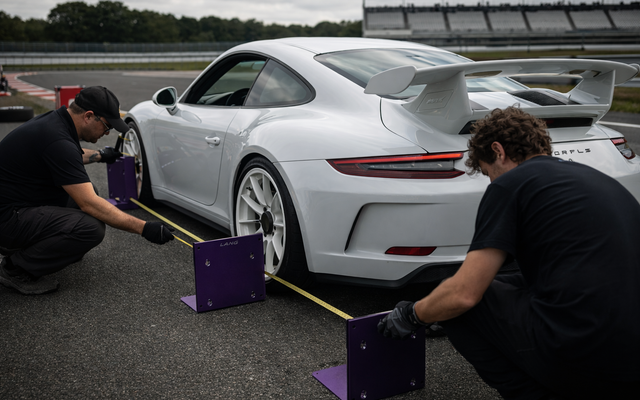
Inside the high-stakes realm of contemporary pro-level sliding, victory is far more than exclusively a product of brute engine power or pilot courage. Rather, it has become a complex science that demands a meticulous fusion of picking a inherently capable car, arming it with the highest-quality drift-spec parts, and, most critically, grasping its real-time characteristics on the course through cutting-edge drift telemetry software. This comprehensive manual functions as your master plan starting from the initial concept of a drift build all the way to the final data-informed adjustments that elevate a powerful vehicle into a predictable podium finisher. We will delve deep into the art and science of car suspension tuning, showing how a modern suspension tuning tool like precise measurement hardware removes guesswork and offers unmatched insight into your chassis's actual performance.
The foundation of any successful drift machine is, without question, the base vehicle itself. Several cars have achieved renowned reputation within the global oversteer scene due to their inherent handling characteristics, durable design, and the vast availability of aftermarket components available. Selecting the optimal platform is the primary and most crucial selection a builder will make. To illustrate, the BMW's E36 3 Series is commonly accepted as one of the greatest overall cars for drifting of all time. Its excellent 50/50 weight distribution, coupled with a driven rear axle configuration and extremely reliable six-cylinder engines, establishes a car that is simultaneously easy to handle for beginners and extremely effective in the hands of a pro competitor. The evolution of this concept, the BMW E46 platform, builds upon these attributes with a even more developed chassis, broader stance for enhanced stability, and still increased steering angle as standard from the OEM. Another powerful platform in the top-level arena is the Chevrolet Corvette C6.
This V8-powered track weapon offers a unique set of benefits to the sliding sport, featuring a lightweight aluminum chassis, a transaxle-style gearbox and differential unit that helps create an perfect front-to-rear mass ratio, and the immense torque of a large-displacement LS-series V8 engine. This combination renders it an absolute monster on track, designed of entering and maintaining long drifts with seemingly effortless use of power. For builders looking for outstanding bang-for-the-buck, the 350Z model Nissan stands out as a excellent example. It arrives from the factory with a stiff body structure, a competent OEM LSD, and the responsive V6 motor that provides sufficient power and torque for mastering and moving up in the discipline. Its follow-up, the Nissan Z34, offers more improvements in structural rigidity, suspension design, and outright engine output, cementing its place as a common pick among professional pilots. Additional legendary platforms that warrant attention encompass the nimble unique Mazda FC, the most popular Nissan S13 240SX, the torque-rich Ford SN95, the more recent BMW E90, and the tiny yet incredibly fun and forgiving MX-5 Miata. Each of these platforms provides a distinct palette of attributes, challenges, and possibilities, but they all have in common the basic ingredients necessary to serve as a capable drift car.
However, selecting the correct platform is merely the beginning. To access the true potential of every of these vehicles, significant upgrades to the steering system and damping and springing systems are completely non-negotiable. This is where the realm of performance aftermarket hardware enters sharp focus. The one most game-changing improvement for a dedicated competition vehicle is the fitting of a drift-spec drift angle kit. These sophisticated kits, like those engineered by industry leaders like specialist manufacturers, are designed to significantly expand the vehicle's available lock-to-lock rotation. A standard production vehicle is highly limited in how far its steering tires can pivot, a design trade-off for daily use. In sliding, conversely, extreme countersteering is continuously needed to catch and hold a drift. An modification kit replaces the factory uprights, linkages, and potentially control arms with components that permit the front tires to achieve steering lock beyond 70 or even 80 degs, as opposed to a normal OEM angle of around 40 to 50 degs.
This tremendously greater steering angle provides the pilot with dramatically enhanced control during a drift, enabling it to be much more straightforward to begin a slide, hold it through a long corner, and transition fluidly from one side to another. The improvement in handling is truly revolutionary. Coupled with a properly specified steering kit is the equally vital upgrade to the car's damping system. Store-bought or even premium sport dampers are just not engineered for the unique and extreme needs of competitive oversteer. A drift-spec pair of adjustable dampers is crucial. These specific coilovers feature unique piston tuning and spring strength that are tuned for the violent weight transfer that is typical of aggressive driving. When a pilot starts a drift, the chassis's inertia is transferred forcefully to the outside of the bend. Correct drift-spec coilovers handle this movement in a predictable fashion, enabling the car to settle promptly and providing the driver accurate feel through the steering wheel and cockpit. They additionally allow for accurate adjustment of ground clearance, damping firmness, and corner weighting, which are all fundamental parts of fine-tuning the vehicle's handling to a given circuit or competition technique. As a system, a precision-engineered angle modification system and a correctly specified system of drift-spec suspension units are the undeniable mechanical cornerstone upon which all subsequent refinement is constructed.
Once the fundamental hardware is in place, the next essential phase in the build is the detailed tuning of the chassis's wheel angles. This is the world of car suspension tuning, a procedure that can feel daunting to the uninitiated but is, in reality, the defining factor to converting a collection of high-performance components into a unified and consistent machine. The most debated element of alignment for sliding is undoubtedly camber angle. Camber angle is the inclination of the wheel relative to the upright axis when viewed from the forward of the vehicle. When the upper part of the wheel is angled towards the chassis, this is referred to as negative camber. In drifting, negative camber on the front tires is universally used and is considered critical. The purpose is deeply linked to tire contact.
When a chassis is turning at limit slip angles, the chassis tilts towards the outer of the turn. This lean makes the outer front tire to lose its optimal footprint with the asphalt. By applying inward lean, the tire is pre-angled to compensate for this roll. As the vehicle leans into the bend, the outside front tire flattens out on the track, optimizing its bite at the exact point when it is needed most for directional command. Commonly, front camber settings for a competition drift machine range from approximately -3 degrees to as extreme as -5 degrees or even more, based on the parameters of the vehicle setup, tire selection, and pilot preference. The rear axle wheels also utilize negative camber, but the values are generally less and less aggressive than the front axle. Overly aggressive inward lean at the rear can result in the chassis excessively loose and difficult to predict on acceleration input, as it diminishes the available contact patch of the driving tires during forward power delivery. Therefore, rear axle adjustments are frequently in the range of -1 degree to -3 degrees, achieving a precise compromise between providing adequate lateral bite to help in entering and maintaining the drift while simultaneously keeping effective hook-up for exiting the turn. Camber is merely one element of the more complex suspension geometry picture, which furthermore encompasses toe, self-centering steering, and steer correction correction.
Toe setting describes the angle of the tires when viewed from a bird's-eye view. Inward toe means the front edges of the tires are closer together than the trailing edges, while toe-out means the converse. For drifting, a modest amount of front negative toe is frequently run to quicken the initial response handling feel, making the vehicle feel more responsive and willing to begin a drift. Rear axle toe is generally set to zero or a extremely slight amount of inward toe to foster predictability under acceleration. self-centering is the forward or backwards tilt of the kingpin axis when observed from the side of the chassis. Positive positive caster enhances steering feel and high-velocity solidity, and it also adds to negative camber increase during steering, which is highly advantageous. Setting these parameters is a complex interaction where a modification to one parameter can and often will influence the others. The old-school process for dialing in a car's suspension geometry for competition has for a long time been a time-consuming endeavor of guesswork and adjustment. A pilot or engineering group would make a change based on intuition, test the chassis on track, depend on the driver's personal sensation and comments, and then introduce an additional adjustment. This cycle would continue again and again until the chassis felt "acceptable" or the scheduled track time ran out. This approach is not only extremely slow in terms of man-hours and costs, but it is furthermore deeply flawed.
Pilot perception is a infamously inconsistent metric, colored by numerous variables such as tiredness, varying track surfaces, ambient heat, and just the mindset of the pilot on that specific session. What feels "oversteery" on one run might feel "tight" on the next lap, leading to confusing data and counterproductive tweaks. This traditional limitation in chassis setup is exactly where contemporary engineering tools has intervened to revolutionize the process.
The development and application of sophisticated vehicle dynamics tools has introduced a radically different age for engineering and optimizing competitive sliding vehicles. This new generation of tools, exemplified by cutting-edge systems like modern telemetry hardware, function by directly recording the live physical performance of the car as it is operated on the track. As opposed to depending on subjective feedback, these systems gather measurable information on key factors such as shock absorber movement, wheel speed, lateral and longitudinal g-forces, lock position, and accelerator and brake pedal application. This acquired data stream is then interpreted by sophisticated algorithms that can plot and analyze the information in a comprehensible manner. For the first time ever, tuners and builders can observe specifically what the vehicle is exhibiting at any given point of a slide. This function changes the complete alignment optimization workflow. Think about the aforementioned challenge of setting the front camber for a given chassis. As an alternative to making a adjustment from -3 degrees to -3.5 degrees and then driving several passes to try and "feel" a change, a suspension tuning tool can deliver real-time and irrefutable information. The software can display in a chart how the tire's grip is acting during the critical stages of a angle: initiation, sustain, and changing direction. It can demonstrate if the existing value is allowing the outside front tire to keep ideal contact or if the tire is over-stressed on its external edge.
The system can subsequently suggest fact-based recommendations for change. Perhaps the telemetry reveals that the outside front tire is still overloading its edge at -3.5 degrees of negative camber, implying that a move towards negative camber, say -4 degrees, might be beneficial. On the other hand, the information might show that the tire is not reaching optimal operating temp or that the inside edge is degrading unevenly, which could point to that there is too much negative vehicle dynamics tool camber and a slight reduction back to -3.2 degrees would be better ideal. This degree of accuracy and useful intelligence was literally impossible in the time of exclusively seat-of-the-pants adjustment.
The benefit of employing a dedicated drift telemetry system reaches much further than only setting alignment. It functions as an essential damper adjustment manual that is specific to your specific vehicle. When fine-tuning the rebound and compression clickers on your suspension, rather than depending on imprecise advice or copying another driver's numbers, you can employ the data to observe how the chassis is behaving in reaction to your tweaks. The application can display the damper movement trace over a lap, highlighting if the shocks are managing the weight transfer effectively or if they are causing the chassis to oscillate excessively after a flick. It can aid in identifying issues like bottoming out or excessive extension, allowing you to make data-backed adjustments to preload settings, damping values, or ground clearance. This process extends just as well to the detailed process of suspension geometry optimization. Beyond camber, the system can provide analysis into how modifications to toe settings and caster angle are impacting the chassis's handling during different parts of a lap. For example, it can allow you to find the best amount of front axle toe-out for your individual steering rack setup and competition style by showing the quickness of turn-in response and the stability of the car at full lock. This makes the tool an incredibly powerful performance optimization handbook that is actively updated by the real-world dynamics of your personal chassis on the track. It shifts the entire process from a dark art into a scientific development procedure.
Moreover, the application drift tuning app of a system like modern telemetry is in no way confined to experienced engineers with extensive budgets. For the amateur driver, it acts as an amazing force multiplier. It effectively provides the driver with the analysis of a professional suspension specialist without the corresponding overhead. It speeds up the tuning process by providing unambiguous solutions to challenges that would normally take countless track days of experience to solve. A tuner can see how their specific car reacts to specific inputs, gaining a deeper understanding of car control in the journey. It furthermore opens up advanced performance tuning concepts, enabling every enthusiast with the desire to refine their car to achieve it in a systematic and successful manner. This is especially important in a discipline like sliding, where setup knowledge has historically been a closely guarded commodity among top teams. Now, that knowledge can be in the hands of every drift angle kits motivated builder.
In conclusion, the path to constructing and optimizing the ideal championship-contending sliding vehicle is a multi-stage endeavor that smoothly combines classic engineering wisdom with 21st-century data technology. It begins with the strategic pick of a capable platform, then enhanced by the integration of non-negotiable competition parts like drift-spec drift angle kits and properly selected performance suspension units. The journey then advances into the precision stage of alignment optimization, where settings like negative camber, toe, and caster are meticulously configured to match the vehicle's new capabilities and the driver's individual style. The final step, and what genuinely differentiates the contemporary approach from the traditional methods, is the use of a sophisticated drift telemetry software. This tool eradicates the guesswork and trial and error of solely subjective setup by providing quantifiable, live data on how the car is really behaving. It acts as an indispensable engineering partner, a comprehensive alignment optimization handbook, and a comprehensive performance analyzer. As a complete package, this complete approach leads to that each and every component of the competition vehicle—from the choice of the platform to the final adjustment on the damper—is refined for ultimate competitiveness on the circuit. It embodies the full evolution of the sport of oversteer driving, connecting raw pilot talent with surgical suspension engineering to forge the most effective vehicles imaginable.